Ask five different shops how much a Jeep Wrangler lift kit costs installed and you’ll likely get five different numbers, and not because anyone’s trying to mislead you. Lift kit pricing depends on so many variables, the lift height, the kit brand, whether you need new tires and wheels to clear the taller ride, labor rates in your area, that a single flat number rarely tells the whole story. Most owners researching this end up more confused after reading a few forum threads than they were before they started.
This guide breaks down what actually goes into the total installed cost of a Jeep Wrangler lift kit, where the real price differences come from, and what budget range to expect depending on how far you want to go.
What “Installed Cost” Actually Includes
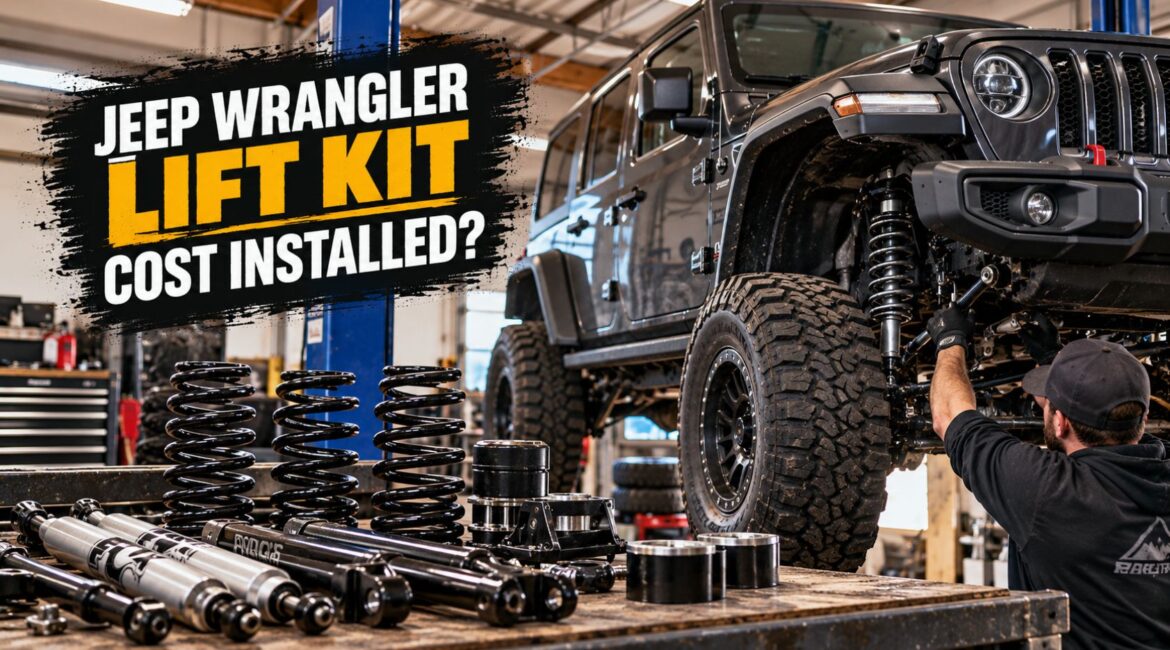
Before getting into numbers, it helps to separate what people usually mean by “lift kit cost” from what the full installed cost actually involves. The kit itself, springs or coils, shocks, control arms, and the various brackets and hardware that come in the box, is only one piece of the total bill. Labor to actually install the kit, which can run anywhere from a few hours for a basic budget-friendly kit to a full day or more for a long-arm system requiring extensive fabrication, adds a significant chunk on top of the parts cost.
Beyond the kit and labor, a proper lift job often requires additional items that aren’t part of the kit box at all: a wheel alignment after the suspension geometry changes, sometimes new or longer brake lines to accommodate the added travel, and very often larger tires and wheels, since a lifted Jeep with stock-sized tires tends to look unfinished and doesn’t take advantage of the extra clearance. Leaving these extras out of a budget is one of the most common reasons people end up spending considerably more than they originally planned.
Lift Height: The Biggest Factor in Cost
How much does a Jeep Wrangler lift kit cost installed largely comes down to how much lift you’re actually going for, since height and complexity scale together. A small leveling kit or a budget two-inch lift sits at the lower end of the price range, using relatively simple components and requiring less labor to install, since it doesn’t demand the extensive driveline and geometry corrections a taller lift does.
Mid-range lifts, typically in the two-and-a-half to four-inch range, step up in both parts cost and labor complexity, often requiring longer shocks, adjusted track bars, and sometimes a transfer case drop kit to keep the driveline angles correct. This range tends to be the sweet spot for most owners who want a meaningfully different stance and room for larger tires without venturing into long-arm or extreme off-road territory.
Lifts beyond four inches, and especially long-arm systems in the six-inch-plus range, bring a substantial jump in both parts and labor cost. These systems typically require more extensive fabrication, control arm geometry correction, and often additional driveline work to keep everything functioning correctly at that height, which is reflected clearly in both the kit price and the hours a shop needs to install it properly.
Budget Kits vs. Premium Kits
Within any given lift height, the specific kit brand and component quality create another meaningful price spread. Budget-oriented kits use simpler components, often basic leaf springs or coil spacers paired with standard shocks, and tend to prioritize an accessible price point over off-road performance or long-term durability under hard use.
Premium kits, typically featuring coilover or remote-reservoir shocks, forged or heavy-duty control arms, and more sophisticated geometry correction, cost considerably more both in parts and often in labor, since premium components sometimes require more careful setup and tuning during installation. For a Jeep that sees regular off-road use, particularly at higher speeds over rough terrain, the ride quality and durability difference between a budget kit and a premium one tends to become noticeable fairly quickly, which is part of why serious off-roaders are often willing to pay the premium.
DIY Installation vs. Professional Shop Labor
A meaningful portion of the total installed cost comes down to whether the work happens at a professional shop or in a driveway with the right tools and some mechanical confidence. Professional installation guarantees proper torque specs, correct alignment afterward, and a shop that stands behind the work if something isn’t right, but that expertise and liability coverage comes at a real labor cost that can represent a substantial share of the total bill, especially for simpler lift kits where the parts themselves aren’t that expensive.
DIY installation can save a meaningful amount on labor for an owner with the right tools, a safe way to get the Jeep up in the air, and realistic mechanical skills, but it’s worth being honest about the tradeoffs. A botched alignment, incorrectly torqued suspension hardware, or a driveline angle issue from an improperly installed lift isn’t just an inconvenience, it can create a genuine safety problem. For anything beyond a basic leveling kit or budget lift, many experienced Jeep owners still recommend at least having the final alignment done professionally, even if the rest of the install was handled at home.
The Hidden Costs People Forget to Budget For
Tires and wheels are the single biggest hidden cost most people underestimate when budgeting for a lift. A taller lift creates clearance for larger tires, and most owners end up wanting to fill that clearance rather than running a lifted Jeep on stock-sized rubber, which adds a substantial amount to the total project cost beyond the lift kit and labor alone.
Alignment, as mentioned, is close to mandatory after any suspension change and shouldn’t be skipped to save a relatively small amount of money, since incorrect alignment leads to uneven, accelerated tire wear that costs far more in the long run than the alignment itself would have.
Depending on the lift height and the specific Jeep model and drivetrain, additional parts like extended brake lines, a transfer case drop kit, or adjustable track bars may be necessary beyond what’s included in a basic kit, and not every kit listing makes clear which of these extras are included versus sold separately. Reading the full parts list carefully, or asking directly, before committing to a specific kit and price avoids an unpleasant surprise once the project is already underway.
Jeep Wrangler Lift Kit Cost Comparison by Category
| Lift Category | Typical Complexity | Labor Involved | Common Additional Needs |
|---|---|---|---|
| Leveling kit / small lift (0-2 in) | Low | A few hours | Usually minimal, alignment recommended |
| Mid-range lift (2.5-4 in) | Moderate | Half day to full day | Longer shocks, track bar adjustment, larger tires |
| Long-arm / large lift (4.5+ in) | High | Full day or more, often multi-day | Driveline correction, transfer case drop, extensive alignment work |
Does a Bigger Lift Always Mean Better Off-Road Performance?
Not necessarily, and this is worth considering before assuming more lift height automatically justifies the added cost. A lift’s main practical benefit is creating clearance for larger tires and improving approach, breakover, and departure angles for serious off-road obstacles. For an owner whose off-roading is relatively moderate, trails that don’t demand extreme ground clearance, a smaller, less expensive lift paired with a reasonable tire size upgrade often delivers most of the practical benefit without the added cost and complexity of a long-arm system built for far more extreme terrain.
Matching the lift to actual use case, rather than defaulting to the biggest option available, tends to produce a better value outcome for most owners, and it’s a conversation worth having directly with whoever’s doing the install before settling on a specific kit and budget.
How Jeep Model and Year Affect Installed Cost
Not every Jeep Wrangler generation is priced the same when it comes to lift kit installation, and this is a detail a lot of first-time buyers overlook when comparing quotes they found online for a different model year. Newer Wranglers, particularly those with more complex electronic stability and ride-height sensors, sometimes require additional calibration or sensor relocation as part of a proper lift install, which can add labor time compared to an older, mechanically simpler Jeep.
Four-door Wranglers also tend to come with a slightly different cost profile than two-door models for the same lift height, partly due to the added wheelbase affecting certain component requirements, and partly because some kits are priced differently by body style even when the lift height is identical. A Rubicon trim with factory electronic lockers and larger stock tires may also need different kit components than a base Sport trim starting from smaller wheels, which is another reason a lift kit price quoted for a friend’s Jeep doesn’t always translate directly to your own.
Financing and Phased Approaches to a Lift Project
Given how quickly the total installed cost can climb once tires, wheels, and alignment are factored in alongside the kit and labor, a lot of owners choose to phase the project rather than doing everything at once. Installing the lift kit and alignment first, then adding larger tires and wheels in a second phase once the budget allows, is a common and perfectly reasonable approach that doesn’t sacrifice the end result, since the Jeep remains drivable and safe at each stage.
Some shops and kit retailers offer financing options specifically because they recognize how much a complete lift project can cost once everything is included, and it’s worth asking directly whether a shop offers payment plans if the full project cost is a stretch. Whatever approach you take, resist the temptation to buy the cheapest possible kit just to hit a lift height target, since the labor cost to install a lift kit is largely the same whether the kit itself is a budget option or a mid-tier one, which means skimping on component quality to save a relatively small amount on parts often isn’t the savings it first appears to be.
Getting an Accurate Quote
Because so many variables affect the final number, the only reliable way to know what a specific lift project will actually cost is to get a detailed, itemized quote from a shop that’s looked at your specific Jeep, not a generic number pulled from a forum thread about a different model or lift height. A good shop should be able to break down the kit cost, labor hours, and any additional parts like alignment, brake lines, or a transfer case drop separately, rather than giving a single bundled number that makes it hard to know what you’re actually paying for.
It’s also worth asking directly whether the quote includes a post-installation test drive and inspection, and what the shop’s policy is if an issue shows up shortly after the lift is installed. A shop willing to stand behind its installation work with a clear warranty or comeback policy is generally a better sign than one offering the lowest price with no mention of what happens if something isn’t right afterward.
Things to Consider Before Budgeting a Lift Kit Project
- What’s the actual intended use, mild trail driving, serious rock crawling, or mostly cosmetic stance, and does the planned lift height genuinely match that use?
- Has the full cost been budgeted, including tires, wheels, alignment, and any additional driveline or brake line components, not just the lift kit box price?
- Is the installation happening at a shop or at home, and if DIY, is there a realistic plan for getting the final alignment done professionally afterward?
- Does the specific kit under consideration include everything needed for this Jeep’s model and drivetrain, or are there additional parts that need to be sourced separately?
- Has the kit’s component quality, budget versus premium shocks and control arms, been matched to how hard and how often the Jeep will actually be driven off-road?
Frequently Asked Questions
How much does a Jeep Wrangler lift kit cost installed on average?
It varies significantly based on lift height, kit quality, and labor rates, with small leveling kits costing considerably less installed than a mid-range two-and-a-half to four-inch lift, and long-arm systems above four and a half inches costing meaningfully more due to added parts and labor complexity.
Does the lift kit price include tires and wheels?
No. Lift kit pricing almost always covers only the suspension components themselves, springs, shocks, control arms, and hardware. Larger tires and wheels, which most owners add to take advantage of the new clearance, are a separate cost on top of the kit and its installation.
Is it cheaper to install a lift kit myself?
It can save on labor costs for an owner with the right tools and mechanical confidence, but it’s worth budgeting for a professional alignment afterward regardless, since improper alignment or incorrectly torqued suspension components can create real safety and tire wear issues.
Why do two lift kits at the same height cost such different amounts?
Component quality is the main driver. Budget kits use simpler shocks and spacers, while premium kits with coilover or remote-reservoir shocks and heavier-duty control arms cost more in both parts and often installation labor.
Do I need an alignment after installing a lift kit?
Yes, essentially always. Changing ride height and suspension geometry affects alignment, and skipping this step leads to uneven, accelerated tire wear that ends up costing more than the alignment would have in the first place.
Conclusion
How much does a Jeep Wrangler lift kit cost installed isn’t a question with one simple answer, since lift height, kit quality, labor rates, and the often-overlooked extras like tires, wheels, and alignment all factor into the real total. Budgeting realistically for the full project, not just the kit’s sticker price, and matching the lift height to actual intended use rather than just going as big as the budget allows, is what separates a lift project that delivers real value from one that ends up costing more than expected while underdelivering on the Jeep’s actual capability.